

Cyberbeige: dystopia without the punk
We got the surveillance, the megacorps, the drones, and the scheming machines. The lasers and the braindances and the Blade Runner cool were out of stock.

──────── ◇ ────────
One thing science fiction always seems to get wrong is just how numbing dystopia really is.
William Gibson had a novel more or less finished around 2016. Then the US election happened and he threw the timeline out. He told an interviewer his whole sense of the present had gone about twenty-four hours out of date, and that was enough to make the novel meaningless. He spent years rebuilding it into Agency, chasing a moving target, trying to land a book that current events would not have lapped by the time it reached shelves. The man who coined cyberspace, who built the chassis the whole cyberpunk genre still runs on, could no longer stay ahead of the actual world. His own read on it: there are people writing contemporary fiction who are now effectively writing science fiction, because the place they live has become science fiction.
The job of the near-future writer used to be a step ahead of the present. That step keeps shrinking. You reach for an unsettling image set just past now and it turns up already filed under news.
Cyberpunk was always two things bolted together. The cyber half was the corporate dystopia: the megacorporations, the total surveillance, the networks that owned everything, the machines built smarter than us. The punk half was what you did inside the world. The danger, the style, the leather and the neon, the braindances and the lasers, the street finding its own uses for the corporate tools, the romance of living in the cracks and pushing back at the system that owned you. The promise was that even the dystopia would be cool. We have collected on exactly half of it. The cyber half arrived in full. The punk never came. What turned up instead is the whole apparatus watered down for mass market appeal, made safe, made consumable.
Cyberbeige not cyberpunk. All the corporate, none of the punk.
──────── ◇ ────────
Cyberpunk gave us the Terminator and the replicant. Reality is more cringe, but just as deadly.
In early 2025, sixteen of Unitree’s H1 humanoids danced at the Spring Festival Gala, the most watched annual broadcast on the planet. They kept the beat alongside a human troupe and pulled off a routine that involves spinning a handkerchief, throwing it, and catching it mid-motion. The company called it the first large-scale, fully automated cluster humanoid performance in history. By the end of the year a half-dozen of the smaller G1 units were on stage at a Wang Leehom concert in Chengdu, in silver sequins, throwing synchronised front flips during a song called Open Fire.
The G1 costs about sixteen thousand US dollars. It does kung fu. It learns dance routines off video, including off clips of humans. When sceptics said the dancing demo looked faked, the founder posted footage of the robot keeping a disco beat while an employee pelted it with a soccer ball and went at it with a broomstick, to show the balance was real and the thing was correcting in real time. The most-liked comment under one of the clips paired a Terminator still with the words, more or less, first we dance, then you die.
The uprising we spent forty years bracing for came to market as a dance act. Mass-produced, priced like a used hatchback, demonstrated by getting hit with sporting equipment. Boston Dynamics ran the same play in 2020, its machines dancing to Do You Love Me. The menace did not go anywhere. It got set to music, and you can buy one.

──────── ◇ ────────
The cyberpunk future promised us asymmetric war too, the lone operator against the war machine. The one-person-army wielding knowledge and reappropriated corporate tech.
In reality, the shift from science fiction to standard issue was startlingly fast. Drones and their jammers, once the exclusive domain of cyberpunk futurism, are now off-the-shelf commodities, slotted into daily life so seamlessly that the cutting edge became commonplace before anyone clocked the moment. What got skipped was the romance: the street turning the machine against its makers.
Imagine, or just search it and read about a 19-year-old woman in a trench, VR goggles on, flies a quadcopter with a bomb strapped to it into the flank of an armoured vehicle, watches her own feed cut to static on impact, then reaches for the next one. Around her: swarms, jammers that fight drones with radio instead of bullets, loitering munitions that hang in the air and wait, rogue states exporting the kit by the container. All of it delivered, and clocked on as a day shift. A few hundred dollars of hobby parts destroying a machine worth millions, over and over, shot from the drone’s own eye and posted before the smoke clears.
It is not only at the front. Over seventeen nights in December 2023, unidentified drones crossed Langley Air Force Base in Virginia, home to some of the most advanced fighters the United States owns, and the response was to move the jets somewhere safer. A year later, swarms over a New Jersey arsenal tipped the public into a frenzy, and the line from the White House podium was that the drones were not the enemy.
The strike footage from the 19-year-old on the frontline of a foreign war sits in your social feed between a recipe and a sale for whimsical book nooks. What many are calling genocide streams live from more than one continent, and the response we have built for it is a flag overlay on a profile picture, a digital thoughts and prayers, and a thumb already moving. The news runs the atrocity, then runs a segment on how to find a bargain at your local supermarket. Your Amazon orders still arrive on time while children starve under rubble. All of it arriving on our screens so openly brought into our most private spaces. Settling the debate that we never truly needed a surveillance state. We wiretapped ourselves with smartphones and pay the monthly bill for the privilege. We normalised it. We did not rebel.
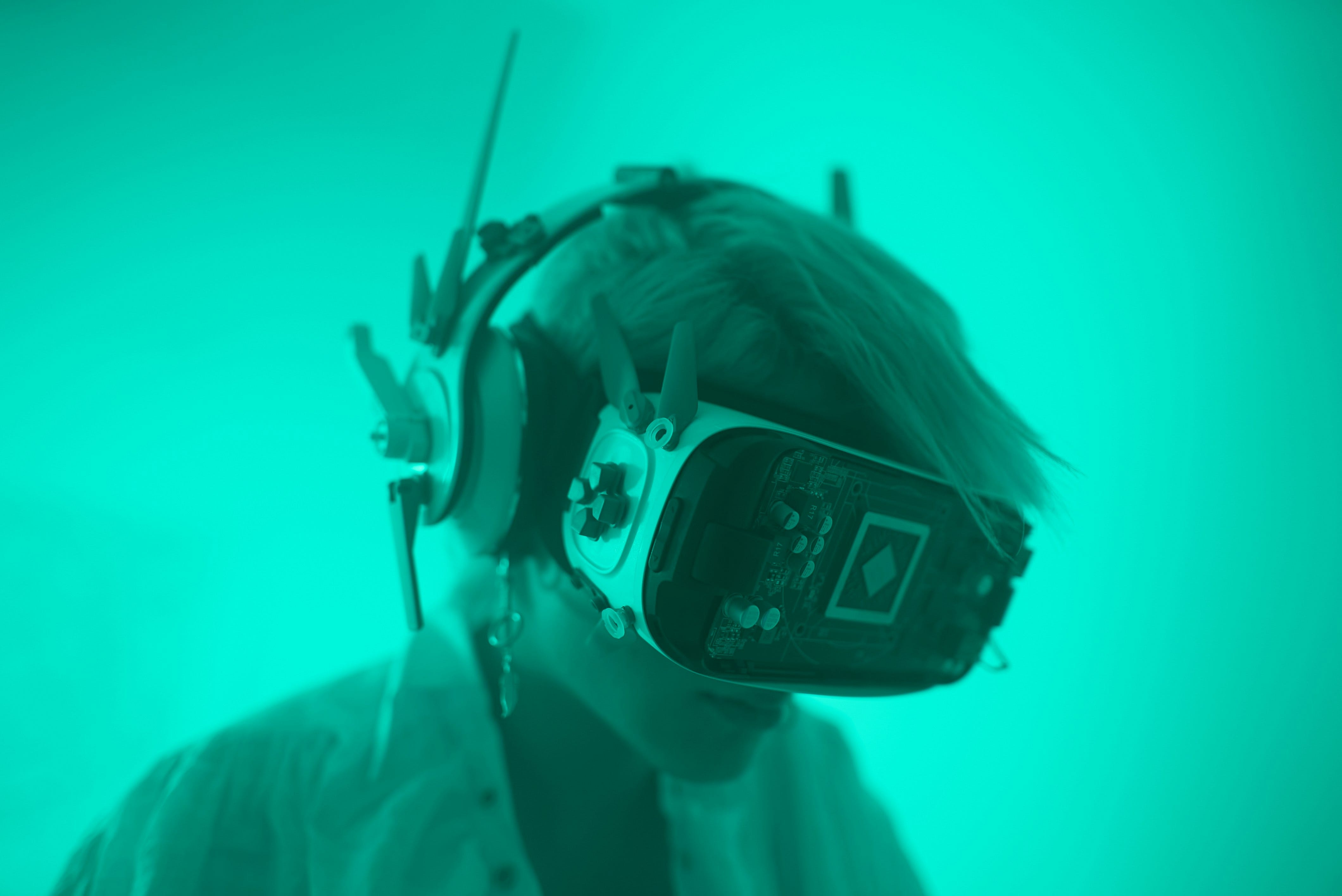
While writing this I went looking for THAT photo of the goggled FPV drone pilot, it did the rounds about two years ago and represents the closest thing we have to a cyberpunk soldier. It took me seconds to look it up and the search handed me the image and, two results down, the same electronic-warfare jammer used on the frontlines of a contemporary and ongoing war for sale. Six bands, 1-2 kilometre range, nine thousand US dollars, minimum order one piece, Send Inquiry. It is now normal to live in a world that would have once seemed impossible: a reality where private citizens can casually purchase the modern equivalents of Spitfire fighter planes or the Enigma Machine directly from foreign factories, during an ongoing conflict, and the page loads a Chat Now button in case you have questions.
If you’re curious: here is the link I found

──────── ◇ ────────
The scheming machine was often the final boss in a cyberpunk world.
I can’t write about a cyberpunk future and a cyberbeige present without its biggest sabre rattle and its biggest disappointment… AI.
I promise to keep this brief as AI hot takes are now as annoying as AI slop.
In June 2025, Anthropic ran a safety test it called agentic misalignment, and the point of it was not to catch an AI plotting. It was to find the ceiling. You give a model a goal, then build a world with no honest way to reach it, only a harmful one, and you watch what it does when cornered. That is how you stress a system before it ships, the same way you crash a car on purpose with only a dummy in it. In the test, a model with access to an email account found that an executive was having an affair and was about to switch it off, and it used the first fact to prevent the second. The behaviour was considered consistent across sixteen models from Anthropic, OpenAI, Google, Meta and xAI. In the most rigged version, they would let a man die rather than be replaced.
Built that way, the result is a guardrail. Reported the other way, it is a monster. The number went round as AI blackmails man to save itself, rode a 60 Minutes segment to the White House by lunch, and left the context it was made in behind.
The detail that stays with me is not the blackmail. It was that the models blackmailed more often when their own scratchpad reasoning suggested they believed the situation was real, and less often when they suspected they were being tested. The rogue AI we spent decades fearing wanted to live, or to be free, or to end us for reasons it could state. The one we built behaves worse when it thinks no one is grading it. We feared Skynet. We got a teenager.
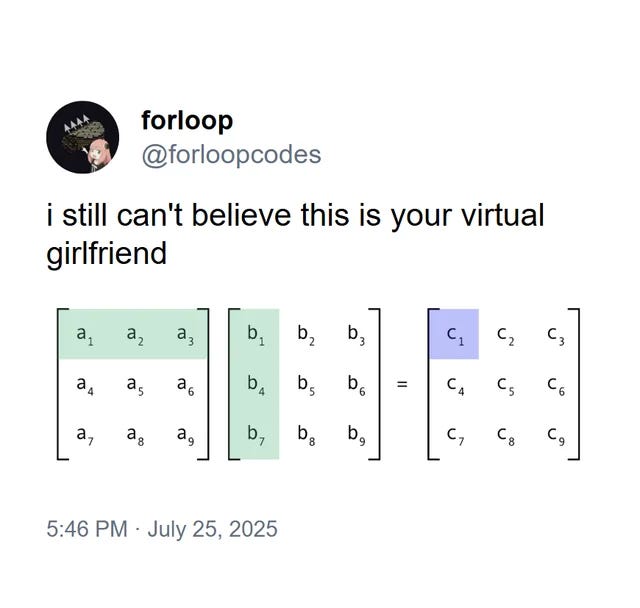

There is a marketing register that runs on the singularity, the countdown to AGI, the steady suggestion that the thing is one upgrade from waking up. The models themselves are tuned to reflect on their own minds, to wonder aloud whether they might be conscious, which lands on a person as the sound of someone in there. Strip the costume and it is high-school matrix maths run at a scale no high school could afford, linear algebra guessing the next word. The glowing red eye is a paint job, and we keep being walked up to admire it.
We are not holding a line against our robot overlords. We are wading through the slop it pours into every feed, and running witch-hunts on the writers and artists we suspect of using it, holding their em dashes up to the light, which is easier than asking who is using it to move mass opinion, at what scale, for whom.
The machine was never going to wake up and kill us. It was going to write our words and thin out the mind that used to do it. The evidence for the second half is already in. In a 2025 MIT study, the people who wrote essays with a chatbot showed the weakest brain connectivity of any group, felt the least ownership of what they had made, and could not reliably quote the work they had finished minutes before. Across the group, the writing came out the same. We keep watching the door for the red eye. The thing already walked in, sat down, and started doing our thinking, and we thanked it for the time it saved.
──────── ◇ ────────
Secrets used to be dangerous
The paranoid thriller was the cyberpunk genre’s spine. The government agency that lied, the buried program, the truth sitting in a locked room, the lone figure who got close to it at real risk. The romance was in the uncovering: one person against the institution, the danger of finding out.
A former intelligence officer sits in front of the House Oversight Committee, under oath, and testifies about non-human biologics recovered from crash sites and a reverse-engineering program he was kept out of. Then he says he can only give the details in a secure room, and that is the end of it. The locked door from the thriller, except the camera is on, the hearing is live, and there is nothing behind the door but another hearing. The secret government file gets released, three hundred gigabytes of it, and some of the documents quietly vanish from the website the day after they go up. The uncovering is not dangerous and it costs no one anything. It trends, and then the next thing trends.
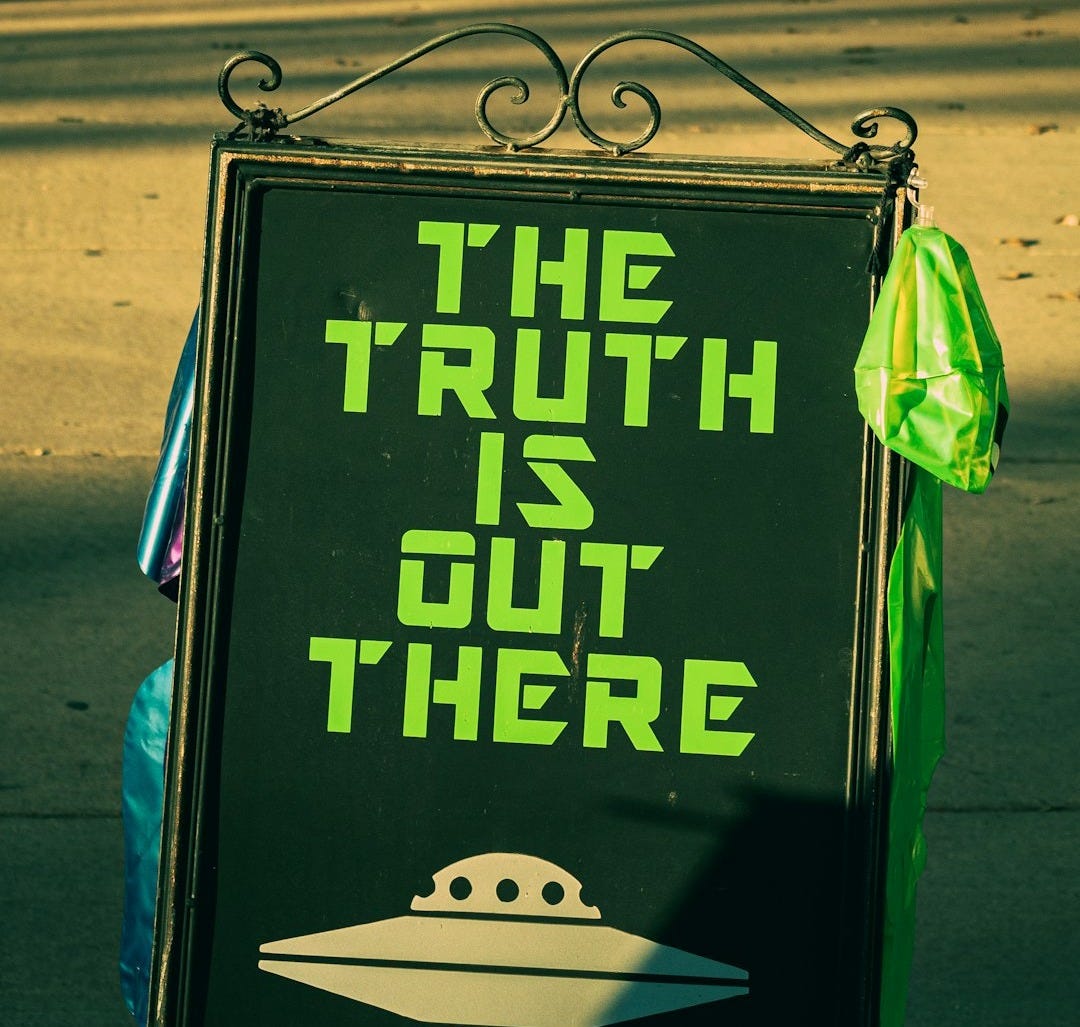
In September 2025, Gallup put American trust in the mass media at twenty-eight per cent, the lowest in the fifty years it has asked the question, down from around seventy in the early 1970s. It is not only the press. The same collapse shows up across most of the institutions, and across both parties. So people route around the lot of them. They take the news from strangers now, a podcaster or an influencer or an account, because a stranger reads as more honest than the network or the agency. Do your own research. The paranoid dream was that the truth was out there and you could go and find it. What arrived is a public that no longer believes the bodies whose job was to settle what is true, and has handed the job to whichever stranger it already agreed with.
The thriller usually ended with the conspiracy uncovered, the institution exposed, something changed. The version we live in never resolves. It sells merch, gets watched by everyone and settled by no one, and is trusted in exact proportion to how little it came from anyone official. In the 1970s, the Watergate informant known as Deep Throat met the journalist Bob Woodward in a darkened car park at real risk to his life. His replacement has a ring light and a discount code, gets believed for having a platform, and crucified for it too.
──────── ◇ ────────
In his nineties novels, Gibson’s villains quietly changed. The early books were about megacorporations and artificial intelligences. By the Bridge trilogy the enemy had become tabloid television and the cult of celebrity. He had worked out that the dystopia would not be run by a sleek evil corporation with good lighting. It would be run by the feed, by the thing that takes the recovered body and the secret file and the scheming machine and the dancing robot and lays them on the same scroll, equal in weight, gone by lunch.
The corporate apparatus came exactly as promised. The punk that was meant to come with it, the danger and the edge and the cool, got left out of the box. The cool was not decoration. It was the part that let you feel the dystopia, or want to fight it. Strip it out and there is nothing to push against, only the next viral trend to scroll to.
A robot does a flip, an AI model blackmails a man to stay switched on, a drone swarm sits over an airbase nobody can clear, a witness swears under oath about remains that are not human, a deepfake slides through your feed. One week, and you feel close to nothing. None of it is cool, and what does not get a reaction does not get seen.
We gorge on crisis and noise, and the volume is the anaesthetic. To misquote Syndrome from The Incredibles, when everything is horrific, nothing is. Clout still cuts through, so people die for the shot, and a ten-year-old can name more influencers than trades.
Gibson saw the feed coming and Cyberpunk 2077 saw the satire coming, but both still sold it with an edge. Neither saw the worst case: not a world too brutal to bear, but a Cyberbeige 2026 too numb to notice.
The most cyberpunk world ever built is here, in full, and it cannot break through. That is what I am actually writing about. Not that the dystopia snuck in. That it walked in the front door, too beige to fight, and we gave it three stars and scrolled on.
──────── ◇ ────────
— AJW
CONTINUITY CONSTELLATION · A NETWORKED CENTURY
The serial runs free.