

THE HOST - PART 1: THE CONSULTATION
CONTINUITY_CONSTELLATION/TCP:01_TCM/The Host/PART_1: THE_CONSULTATION

STORY 2 OF THE SERIAL PORT SEASON 1
──────── ◇ ────────
Continuity Year 45
She had always liked the widowers who came early. The early ones were the ones who had decided.
The widower for the Thursday afternoon arrived early. She watched him from the kitchen window. He stopped at the gate. He found her name on the small bronze plate beside the buzzer. He set his hand on the buzzer. He did not press it. He stood there. The hand had decided. The man had not yet caught up. Then he pressed it. He came up the brick path through the front garden, the path she had laid herself. She opened the door before he reached it.
Hello, she said. Welcome. Please come in.
Thank you, he said.
His name was Curt Giel. He was thirty-eight. He was a widower. He worked metal. The booking form had told her these things, and one more: in the box that asked who he was hoping to be reunited with, he had written Laura, my wife, where most of the widowers wrote my late wife. She had liked him already on the strength of that.
She walked him through the front rooms of the cottage to the office at the back. The office had been built years before. The conservatory had been added later. The conservatory was where she held the consultations. The light through the side window came in warm at that hour. The brochure was already on the low table. The tea was steeping in its pot. Two cups sat in their saucers. She had everything ready, as she always did before a client arrived.
Sit anywhere you like, she said.
There were three chairs in the conservatory. A wing chair by the window. A small leather two-seater. A floral chair across the low table from her own. He chose the floral chair. The good ones chose the floral chair. The very good ones chose it without being shown.
She poured his tea. He took it black. She let the silence sit. The widowers who could sit in the silence were the ones who could sit in the day, and the day was always longer than the consultation.
How long have you been thinking about this, Curt? she said.
Since the funeral, he said. A while now.
She smiled at him. She meant the smile.
We have a lot to talk about, then, she said.
She opened the brochure to the first page. The brochure was a thing she had paid a designer to make for her years before, when she had decided to be the host who looked the most like a wedding planner, because that was what would make her clients the most comfortable. The first page was a photograph. She stood in front of a couple inside the rendered reunion suite. She was smiling. The rendered couple smiled back over her shoulder. The couple was Mike and Sarah. They had been her clients in the spring. The thank-you card from Sarah’s parents was framed in the hallway. Mike’s mate had texted her the week before to refer a friend.
This is what we offer, she said. We call it the package because it includes everything. The ceremony. The venue. The team. The day. Once you have booked the date, there is nothing else you need to do but arrive. We will hold you.
She turned the page. The schedule was printed on her letterhead, laminated.
Your day starts at eight, with my prep here at this house. At eleven, you and your close family will have lunch in the rooms we just walked through. From twelve to three, you will have the get-ready, with our photographer here for the prep shots and me moving between rooms. At three, you and I travel together to the venue. At three-thirty, we have the public ceremony in the marquee on the lawn at the venue, with your guests. That is where you will say your vows to Laura, sign the documentation, and confirm sound mind for the legal-and-industry record. Then I take you through the venue’s interior door for the private session, which is the upload itself. Your guests will be on the lawn during that time with drinks and canapés and lawn games, the way they would be at the photo window at any wedding. At six, the reception opens, and you and Laura are reintroduced on the screen for the room. Then dinner.
She watched his face. The widowers who could read the schedule without their eyes catching on the private session line were the ones who had decided. He read it without his eyes catching. He read it again.
When you say upload, he said, I want to be sure I understand what we are talking about.
The work the network does, she said gently, is what you would have read about. Once Laura was there, in the hospice, when the hospice did the mapping, she was on the network. She is still on the network. The network is what holds her. What we do at three-thirty on your day, with the vows and the documentation, is the legal-and-industry record. What we do at four, in the private session, is the work itself. We move you through. When you wake on the other side, it will be in the rendered space, and Laura will be there, and the part of you that is in this room will have completed.
The documentation says it in plain words, she said. It says that the work moves you through. It says the body in the room does not move with you. It says you understand that, and that you choose it. We have to have it on paper. We have to have you confirm it aloud at the lectern, in front of your guests. It is the industry’s mind-soundness requirement. Every host does it the same way. It is the same form everywhere. The form is the thing that makes ours a ceremony rather than a hospice mapping.
I have read everything about it, he said. I have wanted my own day for a long time.
He held the schedule for a long moment.
Thank you, he said. That is very clear.
Most of my clients, she said, find the schedule the most comforting page in the brochure. The day moves on its own, and you can hold the schedule in your hand and know what is happening at every hour. Some of them carry it folded in their pocket through the day itself.
He folded the schedule in half and slid it into the inside pocket of his jacket without looking down.
She turned the brochure page again. The next page was the team. Photographs in colour, professional, each one with a name and a role. Her husband’s catering brand was printed at the top of his photograph. His apron in the photo carried the same logo. The florist friend’s photograph was the one of her in the garden at the back of her own place, holding the secateurs, smiling. The caption read Jen (Pip), the nickname half the town had used since they were children. The marquee woman. The woman who did the bar. The woman who handled the music.
This is the team, she said. They are also the reason we can do what we do. Every one of them has been with me for years. Most of them since the beginning. Tom is my husband. He runs the catering. He will be doing the lamb the Friday before and the spit roast the Saturday morning. Jen will do the flowers. She has done every ceremony of mine. She will come up to the venue on the Friday and stay through the Sunday clean-up.
She pointed at one face, and then another. He looked at each one.
The reason I tell you this, she said, is because some clients want to meet the team before the day. Most do not. There is no requirement. You can meet whichever of them you want to meet, or none of them, and the day will be the same.
Her phone rang on the side table. She glanced at it.
That is Helen, she said. The marquee. May I take it for a moment.
Of course.
She lifted the phone and stepped toward the window, so she was not standing over Curt while she spoke. Helen, hi. Yes, I have her booking. I am with a client. Yes, the gold cloth for that one. Hers is the Saturday after, you have plenty of time. Yes. Yes. All right. Thank you, Helen. Yes. Bye.
She came back to the chair and put the phone face-down.
Sorry, she said.
Don’t be, he said. It is good to see how it works.
She smiled. It was the smile she gave the ones who said that. The ones who said that were the ones who would arrive early on the day too.
She turned the brochure to the back page, which was blank, and used the blank page as a writing surface for the form she would fill in by hand. She picked up her pen.
Tell me about Laura, she said.
He had been waiting for the question. He had the photograph ready in his hand. He passed it across to her. She took it carefully, by the edges, and looked at it for as long as it asked to be looked at.
It was a kitchen. Morning light through a window over a sink. Laura at the sink, in a long shirt, bare feet, half-turned to the camera, smiling at whoever was holding it. Curt was holding it. The kitchen was small and yellow and one of the cupboard doors was open above her head.
She is beautiful, the host said.
She was twenty-nine, Curt said. We had been newly married. That was the kitchen at the first house. I had just come back from a run. She was making tea. I had taken the leaves down for her before I left, and left the cupboard open. She could not reach the top cupboard without standing on the chair, and she would not stand on the chair, because she said it made the legs creak.
She is beautiful, the host said again, and meant it.
He took the photograph back and put it carefully into his wallet.
The diagnosis came later, he said. She had eight months. Her parents drove down from the north. My mother flew in. We sat with her in the last morning. Her mother brought a thermos. The hospice did the mapping in the afternoon. Laura was very calm about all of it. She had finished being afraid in the diagnosis week, and she was finished. She died the next morning in her own bed, with me on one side and her mother on the other. The first time I saw her after that was a week later, in the rendered space. She was wearing the long shirt. She was making tea. She had the cupboard door open above her head.
The host did not say anything. She let the silence sit.
It has been a while, Curt said. We have spent a lot of time together. I am ready to come over to her side. I am not afraid of the day. I am not afraid of what it costs. I want to be sure you understand that.
I understand, she said.
She wrote his number, in the row labelled client readiness, that she always wrote when a client was ready.
She turned to the back of the binder and laid out the three Saturdays she had free in October. He chose the second.
Six weeks, she said.
Six weeks, he said.
She wrote the date. She wrote it on the schedule he had folded in his pocket, which she asked for and gave back. She wrote it on the form. She had him sign the form. She had him take a photograph of the form with his phone, so he had a copy. She told him the next steps, in order. The deposit by Friday. The pre-ceremony forms to be filled in at home over the next weeks. The menu choices back to her by the end of the month. The family invitations on a template she would email him that afternoon. She would call him on the Monday before, to walk through any last questions.
He stood. He stood all at once and steady. The good ones did. He thanked her. He held out his hand. She took it.
I will see you on the twenty-second, he said.
I will see you on the twenty-second, she said. I am very glad you chose me.
I am too, he said. Thank you for the tea.
She walked him back through the cottage to the front door. She watched him down the brick path she had laid herself, through the front garden, through the gate. He did not look back. The good ones did not look back. She watched him until he was around the bend.
She came back inside. She closed the office door behind her. She sat a moment on the floral chair across from her own, and let the consultation finish in her body. She had liked him. She had liked him very much.
She got up. She put the cups on the tray. She put the tray on the kitchen counter. She came back to the office. She opened the binder. The next page was an older woman, looking to be reunited with her brother. The consultation was Friday morning. The host turned to the blank page at the back, and picked up her pen.
TO BE CONTINUED…
- AJW
──────── ◇ ────────

The concept cover for my upcoming novel - The Grey Corner, Book 2 of the Continuity Constellation.
Art by Saturnids Art Link: https://mushroomy.house/collections/saturnids
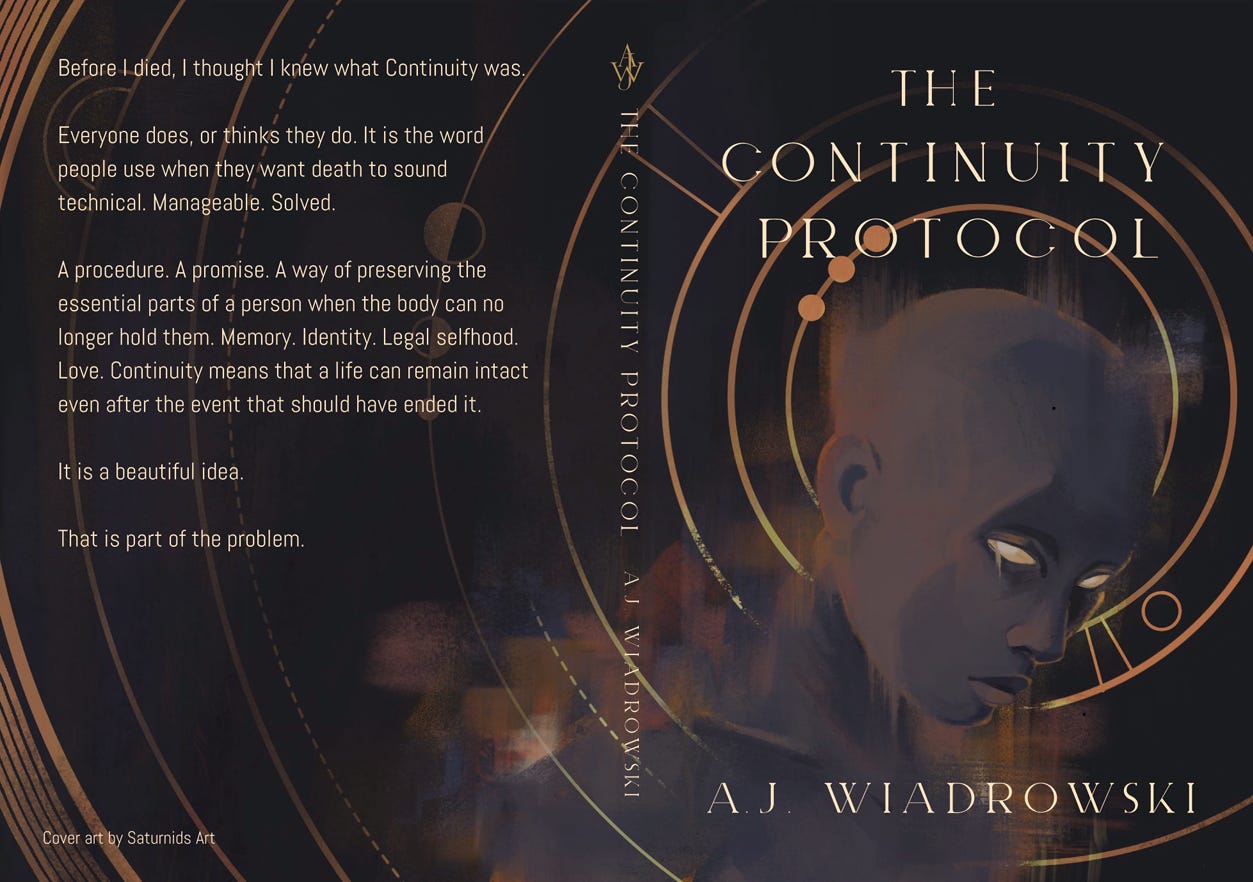
Book 1 of the Continuity Constellation: The Continuity Protocol available on Amazon and indie publishers